Normalize gene symbols
Use modern HGNC names for interpretation, but substitute old names when the frozen bundle requires them.
Atlas / Primary microcephaly
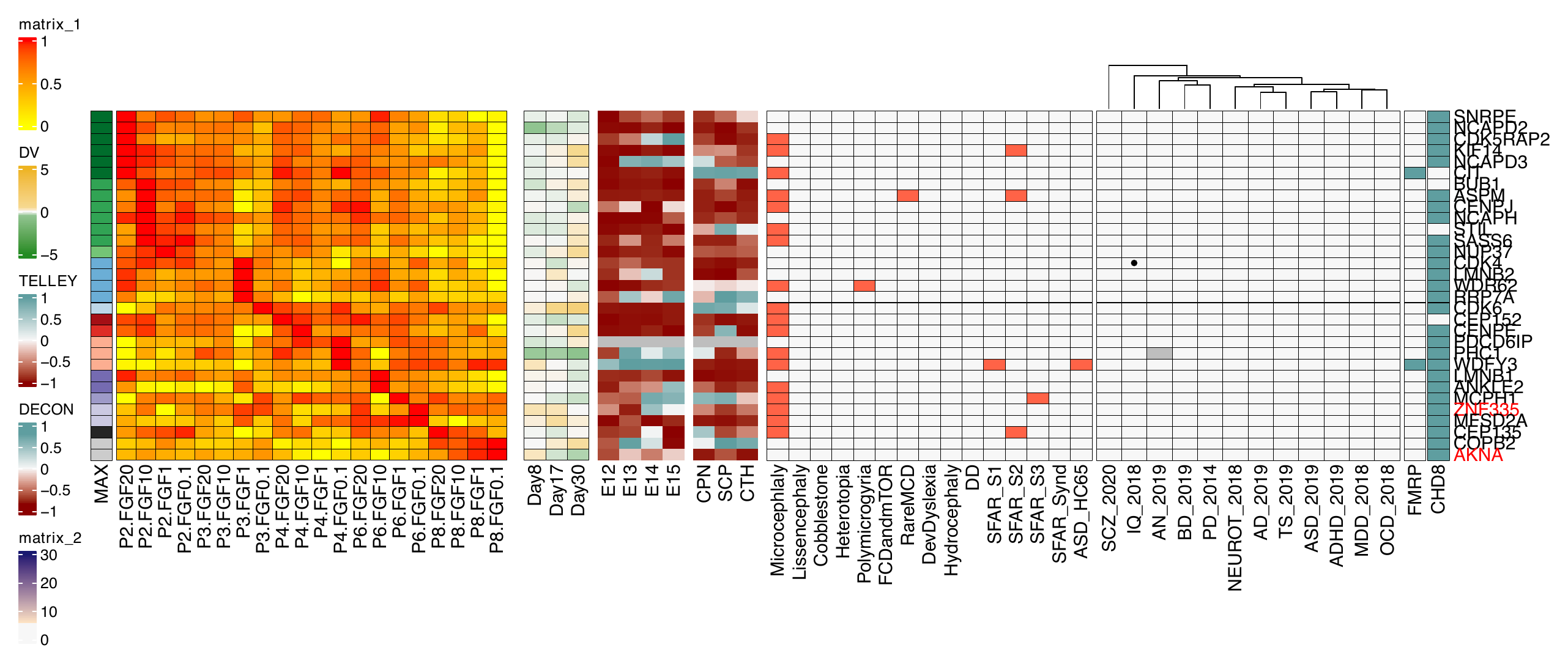
A guided reconstruction of the inherited R protocol and the biology behind it. The atlas keeps the old bundle reproducible, explains the script from syntax to biological consequence, decodes the heatmap block by block, and updates the interpretation with current gene-symbol and database evidence.
Protocol map
Use modern HGNC names for interpretation, but substitute old names when the frozen bundle requires them.
Expression matrices, MAGMA gene-level p-values, GWAS gene lists, disease gene sets, and developmental slopes.
Keep genes present in the bundle universe, then attach every available evidence layer to those rows.
Compress the evidence into one row-aligned figure: expression timing, DV fold change, slope blocks, gene sets, MAGMA, and GWAS dots.
KNL1 -> CASC5 and TRAPPC14 -> C7orf43,
then label the rows with current HGNC-approved symbols.
The original script is not wrong because it uses old names; it is frozen in the naming
conventions and database snapshots of the project that produced it. The scientific risk
is different: if we feed it current symbols without an alias bridge, true MCPH genes
can disappear from the analysis. That happened with KNL1 and
TRAPPC14. A modern thesis-friendly analysis should therefore preserve two
symbol layers at the same time: the bundle-compatible symbol needed to reproduce the
old heatmap, and the current HGNC symbol needed to communicate the result correctly.
Script microscope
Plot atlas
Gene profiles
Database profiles